Controlling in the Eye of Change
The question of how management accounting will evolve is one that we keep coming back to
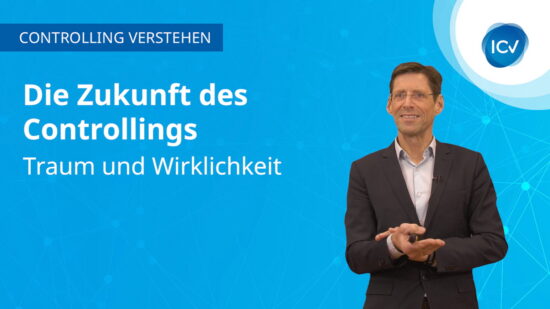
The new video in the “Understanding Controlling” series highlights six key trends that will shape the future of controlling: digitalization/AI, sustainability, demographics, controller roles, complexity, and agility. The speaker, Prof. Dr. Heimo Losbichler, former ICV Chairman, Chairman of the International Group of Controlling (IGC), and Director of the Controlling, Accounting, and Financial Management program at the University of Applied Sciences Upper Austria, Faculty of Economics and Management in Steyr.
Management accounting is facing profound changes. While technological innovations are rapidly transforming day-to-day practices, the fundamental framework of the discipline remains intact. Heimo Losbichler provides a structured, expert analysis of the key developments, fault lines, and future trends in management accounting.
Digitalization and Artificial Intelligence
Digitalization—particularly driven by the rapid rise of artificial intelligence (AI)—is considered the defining game-changer in controlling. While basic technical functions such as data management have already been widely adopted, many companies are still in the early stages of applying AI in more complex areas. The trend is moving away from simple bots toward autonomously operating agents that act as “co-pilots” to support the controller. The goal is to leverage the complementary nature of humans and machines: AI handles data-intensive analyses and routine tasks, leading to a reduction in subjective errors, while the human element remains indispensable for empathy and the ultimate decision-making process in strategic planning.
Sustainability (ESG)
Although regulatory issues such as the CSRD or taxonomy are currently being critically scrutinized in part due to political developments, sustainable management remains an ongoing task. Controlling must give equal weight to environmental and social criteria (People, Planet) alongside economic profit and integrate them into all processes. This not only requires the development of robust non-financial databases but also compels controllers to highlight complex trade-offs in decision-making. In this context, the role of controlling is shifting away from a purely profit-oriented approach toward managing a business model that is environmentally and socially sustainable in the long term.
Complexity
Modern corporate management operates in an increasingly opaque and dynamic environment, where factors often have a momentum of their own or are hidden from immediate view. Since complex systems can only be partially understood, management accounting must acknowledge that pinpoint forecasts remain impossible, even with AI. Instead, the focus is on identifying patterns and building capabilities that match the complexity of the environment. In this context, management accounting serves as a navigator, helping to steer the company safely through turbulent times—despite limited control options—by running through scenarios and applying systems thinking.
Agility
As a direct response to increasing complexity, agility is gaining importance in controlling. The goal is to supplement rigid planning cycles and traditional budgeting with more flexible approaches such as OKRs (Objectives and Key Results) or relative targets in line with the Beyond Budgeting philosophy. This is not just about new methods, but also about building resilience to better cushion shocks—for example, through liquidity buffers. For controlling, agility means, above all, the ability to react quickly and adjust plans at short notice without losing sight of the fundamental direction within the management cycle.
Changes in Controller Roles
The traditional image of the controller as a “jack-of-all-trades” is evolving into a diverse portfolio of distinct role profiles. Companies such as Bosch and BMW demonstrate that a division into specialized functions—such as business partner, business analyst, data scientist, or governance expert—is necessary. While the management partner continues to play the dominant role in direct contact with senior management, the modern world demands new pillars of expertise. In addition to technical, interpersonal, and business skills, digital and technological expertise—including a solid understanding of statistics and AI—is becoming the indispensable fourth pillar in every controller’s profile.
Demographics and the War for Talent
The massive demographic shift means that in the coming years, millions of skilled workers from the baby boomer generation will retire, resulting in a dramatic loss of experience. For the controlling function, this creates intensified competition for talent (Generation Z), who increasingly value purpose, recognition, and flexible working conditions. Managers in controlling must therefore shift away from authoritarian structures toward a role as empathetic coaches and establish a culture of trust. The challenge lies in making the traditional “hamster wheel” of deadlines attractive enough to not only attract young, tech-savvy talent but also retain them in the discipline over the long term.