5 CCS Controlling Competence Spaces
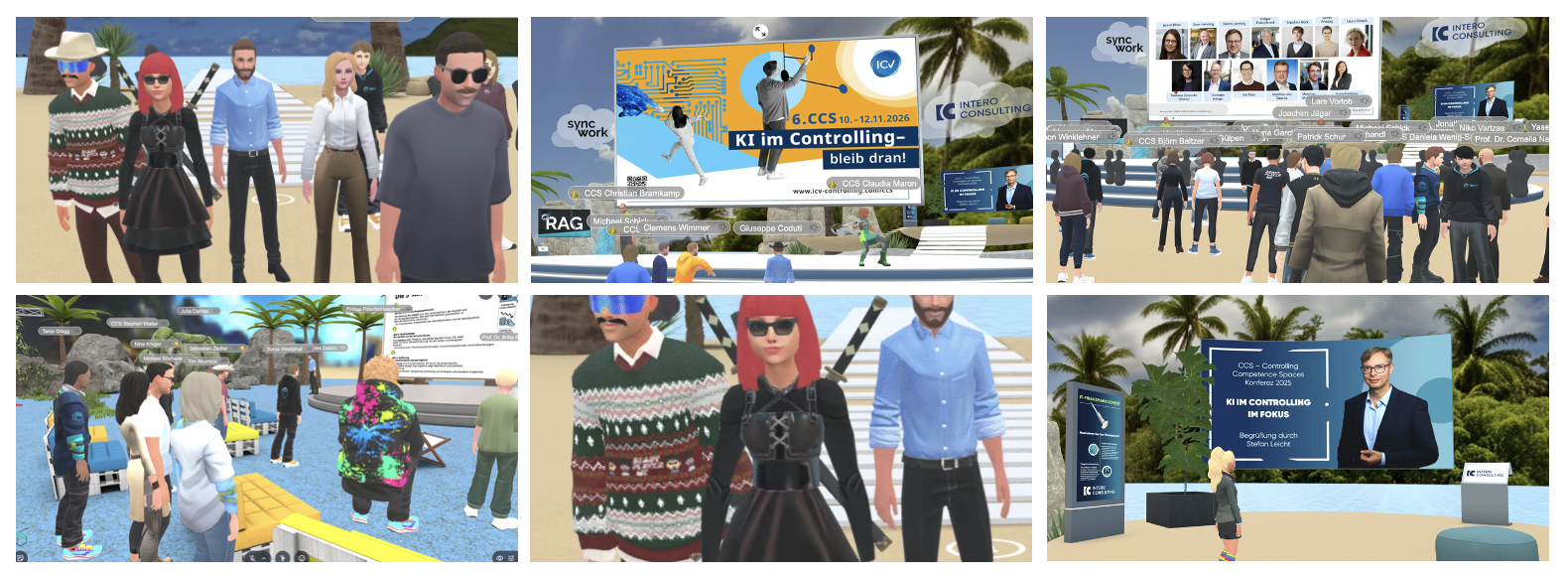
For three days, the virtual ICV conference Controlling Competence Spaces showed how the controller community is reinventing itself in the metaverse – inspiring, interactive and at the cutting edge. From the first avatar flash mob to spontaneous encounters in the Skylight Lounge and the final backflip on the Smart Islands, it became clear that the connection between controlling and AI is no longer a vision, but a reality.
The event kicked off with a keynote speech by Prof. Dr. Matthias Mahlendorf, who broadened the view of the role of controlling in intelligent, data-driven corporate management. In the very first sessions, the participants delved deep into AI expertise, programming and strategic issues for the future: Thorsten Runge showed why controllers are often the better programmers, while Dr. Ramona Casasola-Greiner and Dr. Matthias Böck opened up new regulatory horizons with the AI Act. Holger Piekenbrock introduced a new GenAI project, and Laura Hinsch focused on avoidable pitfalls in AI projects.
The afternoon continued directly with key topics for the future: Prof. Dr. Sven Henning presented success factors for AI initiatives, while Janine Ellner and Fabian Heidenstecker showed how dashboards are becoming real business storytellers. On the virtual stage, Matthias von Daacke, Jannis Friedag and Khai Tran discussed the controller career of tomorrow, and Dr Dennis Janning gave key insights into the risk, impact and responsibility of an AI-first organization.
Day 2 started with a clear view of the economic situation: Dr. Timm Bönke brought facts, trends and nowcasting directly onto the virtual stage with the DATEV SME index. Alexander Hein and Dr. Marina Hein then demonstrated how AI automation and predictive analytics are transforming the finance function. Maximillian Burkhardt made AI agents tangible, Jens Gräf and Maximilian Radlmair strategically categorized the game changer AI, and Sandra Heckmann and Julia Kemmerer translated machine learning into concrete market analyses for the timber industry. Nicolas Hess delved deep into liquidity forecasts, while Dr. Gerald Butterwegge showed how integrated planning works without Excel.
The afternoon offered powerful discussions: Elisabeth Herrle, Kirsten Maître, Marina Meyer, Prof. Dr. Petra Morschheuser and Sonja Westphal gave powerful insights into modern female leadership. Daniel Sälzle showed AI use cases from everyday life, and Stefan Leicht and Katharina Kreiter presented new ways of optimizing costs.
On the third day, Dr. Daniel M. Marks took us on Kärcher’s AI journey – from strategy to initial successes. Kristoffer Ditz opened up new perspectives on automated controlling, and Dr. Kim Louisa Dillenberger focused on the future skills that controllers will need in the future. The afternoon belonged to the deep data sessions: Alexander Hein showed real-time planning in Power BI, Prof. Dr. Fares Getzin inspired with data storytelling, Prof. Dr. Roland Zimmermann positioned knowledge graphs as the backbone of intelligent systems. Together with Andreas Abele, Prof. Dr. Sven Henning presented a maturity model for AI implementation, while Julian Bohn posed the question of how much project management AI can already take on itself. And finally, Dr. Gerald Butterwegge, Sina Redecker and Katja Kretzschmar demonstrated how a traditional company like Mestemacher is achieving a new quality of management with modern BI. Prof. Dr. Martin Tschandl rounded off the program and impressively demonstrated how much of the future is already in forecasting today.
Christian Bramkamp and Claudia Maron led through the three days, accompanied by many other hosts such as Prof. Dr. Björn Baltzer, Hilal Öntürk, Jasmin Engel, Carmen Zillmer, Stephen Walter, Peter Greiner, Saskia Spang, Gabriele Heller, Daniela Wenig-Scheu – and many others who brought the virtual world to life with energy, competence and humor.
The atmosphere? Open, curious, collaborative. The avatars danced, laughed, discussed and networked – and made it clear: AI is changing many things, but the future of controlling remains deeply human. We are shaping this change together, informed, responsible and courageous.
With new impulses, fresh contacts and a lot of tailwind, we are already looking forward to the 6th Controlling Competence Spaces 2026, which will take place from November 10 to 12, 2026.
Updates on this and the next issue can be found here: